Why core spun yarn still matters in modern textile sourcing
In textile sourcing, core spun yarn sits in a practical middle ground: it is not just a decorative yarn, and it is not merely a commodity filament either. Buyers look at it when they need a balance of hand feel, durability, and production stability. That is especially true in knitwear, woven fabrics, and fashion textiles where the yarn has to behave well on the machine and still look decent after dyeing and finishing.
The reason this category keeps showing up on sourcing lists is simple. Garment teams want more than color swatches. They want a yarn that can be planned into production without constant surprises. Mills want consistent cone winding, predictable counts, and enough supply depth to support sample runs and repeat orders. A manufacturer like Ningbo Sinopec Fiber Co., Ltd., with long experience in nylon fiber manufacturing, is positioned for that kind of industrial conversation rather than casual craft retail.
What the supplied product details tell a buyer
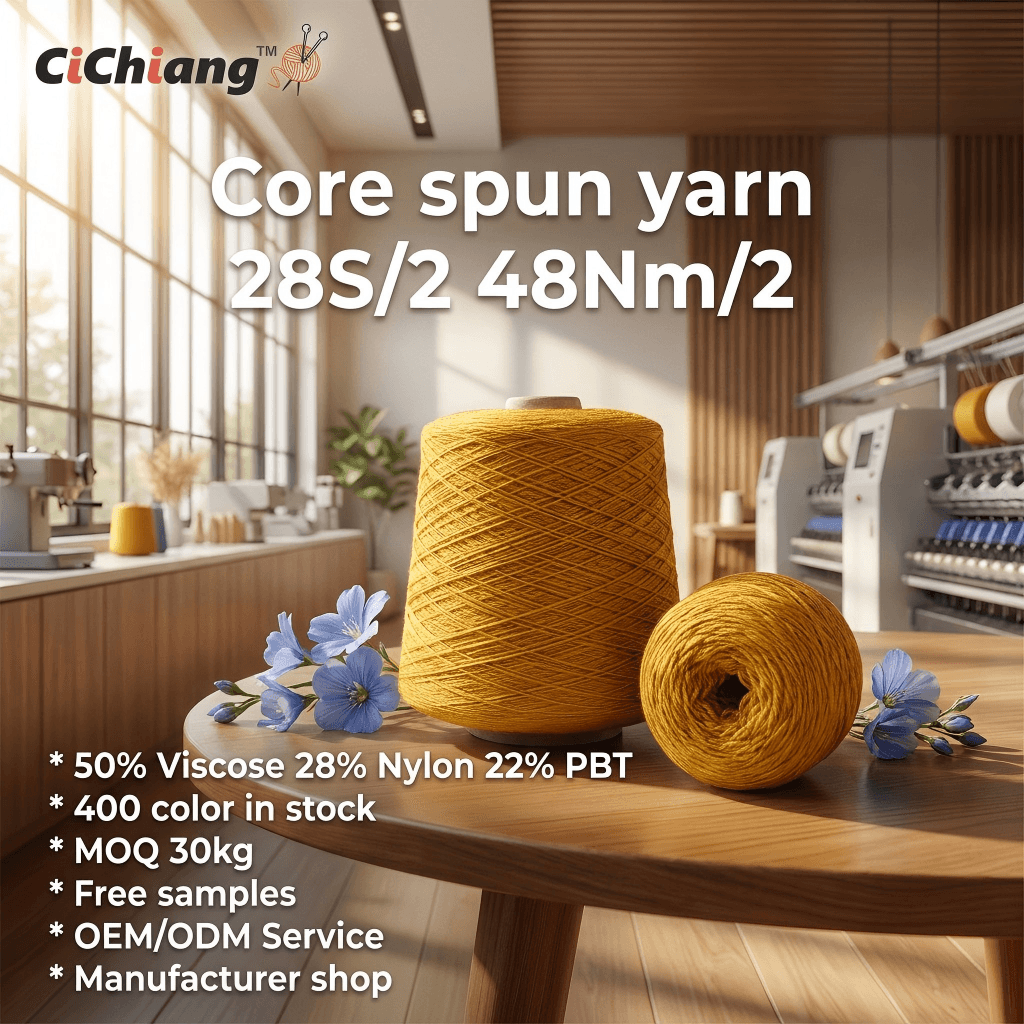
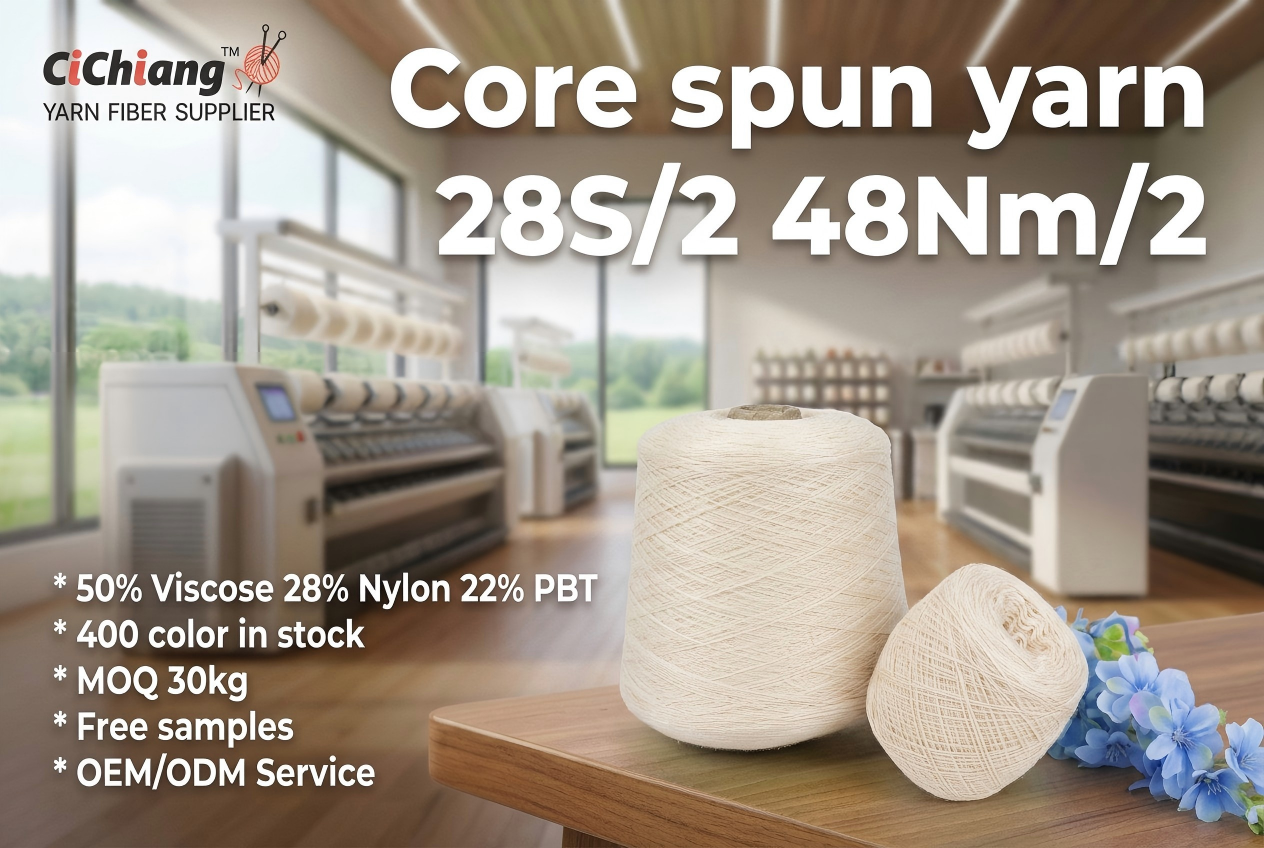
The notes provided with this product point to a yarn offered in multiple colors, with 400 colors in stock, a MOQ of 30 kg, free samples, and OEM/ODM service. Those are the kinds of details procurement teams actually use when evaluating a yarn source. They suggest the supplier is willing to support development work, not just bulk replenishment.
Two technical markings appear in the supplied data: 28S/2 and 48Nm/2. For many buyers, that is more useful than marketing language. It signals a two-ply yarn with a specified count structure, which matters for fabric planning, machine setup, and matching against an existing reference sample. The stated blend is 50% viscose, 28% nylon, 22% PBT. That blend should be treated as the seller’s supplied specification, not something to infer from appearance alone.
Why the construction matters
Core-spun construction is used when a yarn needs the advantages of more than one fiber system. In general, a core fiber contributes performance, while the outer layer influences appearance and touch. That may translate into better durability, a cleaner fabric surface, or more controlled behavior in knitting and weaving. The exact core material is not provided here, so it would be a mistake to assume whether this yarn is elastic, reinforced, or built for a specific stretch profile.
Still, the buyer’s logic is familiar. If a garment program needs both visual quality and production reliability, a blended core spun yarn can be easier to work with than a single-fiber yarn that solves one problem but creates another. That said, the right choice always depends on the end use. A knitwear program has different demands from a woven fashion fabric, and neither should be bought on count alone.
Core spun yarn for knitting versus weaving
For knitting
When sourcing core spun yarn for knitting, teams usually care about softness, stitch formation, and how the yarn behaves under tension. A yarn that looks attractive on the cone can still misbehave on a knitting machine if twist, finish, or winding quality is off. For sample development, the availability of free samples is helpful because it lets technical teams check hand feel and knitting response before committing to production.
For weaving
When the same yarn is considered as core spun yarn for weaving, the question changes. Now the focus is on abrasion, shed behavior, and whether the yarn will hold up under repeated mechanical action. Buyers should ask for process details and testing data rather than assume that a knitting-friendly yarn will automatically perform in woven construction. That is a common mistake, and an expensive one.
How to compare this kind of yarn with other options
Some buyers will compare this type of product with polyester core spun yarn or cotton core spun yarn. Those searches are useful, but they can also oversimplify the decision. Fiber content, hand feel, dye behavior, and end-use expectations matter more than the label alone. A viscose-nylon-PBT blend will not behave like an all-cotton yarn, and it will not be interchangeable with a polyester-based construction unless the fabric specification allows that swap.
If a sourcing team is working with a core spun yarn supplier for the first time, the best move is to compare sample cones under realistic machine settings. Cone appearance is only the starting point. Winding quality, yarn consistency, and shade matching across lots matter at least as much as the nominal count.
Practical buyer checks before placing an order
Ask for the exact intended use, not just the product name. A core spun yarn manufacturer may be able to support apparel, decorative textiles, or industrial textile fabrication, but the fabric target should be clear first. Confirm whether the quoted color is from stock or a custom-dyed match. With 400 colors in stock, that question could save time, especially on development runs.
Also, do not skip the basics: request confirmation of the count, the blend, the package form, and the sample terms. The supplied notes show that this product is sold on cones or spools, with one cone and one smaller wound sample visible in the product imagery. That helps with machine feeding and inspection, but it does not replace a full spec sheet.
What this supplier profile suggests
Ningbo Sinopec Fiber Co., Ltd. says it was founded in 1996 and specializes in nylon fiber manufacturing. The company notes 150 employees, including 20 engineers, a 50,000 square meter factory, and daily output of 100-150 tons, mainly producing PA6 and PA66 polyamide nylon fibers. For a buyer, that profile suggests a manufacturing base with enough scale to support recurring fiber and yarn supply discussions, especially where nylon expertise is relevant.
That does not eliminate the need for due diligence. It simply means the conversation can move beyond basic capacity and into the details that decide whether the yarn fits the line.
Next step for sourcing teams
If you are evaluating core spun yarn wholesale options for knitwear, woven fabric, or a new textile development program, start with a sample request and a written spec check. Compare color, count, blend, and winding quality against your current standard. If the sample performs, then OEM/ODM discussion becomes worth the time. If not, you have lost only a small amount of time and no production capacity.
For buyers building a repeatable supply chain, that is usually the right order: sample first, machine trial second, volume discussion last.